



For this special exhibition, contemporary artisans in handcrafted book design were invited by the Dutch Bookbinding Foundation (Stichting Handboekbinden) to create their own interpretation of Hugo Grotius’s De Iure Belli ac Pacis. Using the 1991 edition Hugo de Groot. Denken over oorlog en vrede (Thinking About War and Peace), compiled by legal historian Arthur Eyffinger and jurist Ben Vermeulen, as their starting point, each artist worked from selected fragments of the original text.
More than sixty bookbinders transformed unbound gatherings into hand-bound books, each offering a unique vision of Hugo Grotius’s enduring influence. Through three rotating exhibitions in the Keuckentoren, visitors can explore this remarkable diversity of interpretations.
Manual Bookbinding | Step by Step
How a book is bound depends on its size and intended use. Is it heavy and large? Will it sit on a shelf untouched, or be consulted frequently? Since the early Middle Ages, the Gothic or English binding has been used for thick, heavy books. The process involves several steps:
- Sheets of paper with printed text are folded into gatherings. Small holes are pierced through them so the book block can be sewn. The sewing thread is looped around cords along the spine — these “bands” make the book extra strong.
- The spine is then rounded and brushed with glue. A thin layer of cotton is added to keep the book block together as one whole.
- Next comes the cover, known as the boards. The cords used to form the bands pass through holes in the boards, securing them firmly to the book block. Whereas wooden boards were once used, cardboard is now more common.
- A strip of supple leather is glued to the spine. By tightening a cord along the bands, the leather is pulled snugly over the book.
- The title label is also made of leather. Letters are carefully pressed into it with gold foil.
- Finally, decorative paper and other embellishments complete the book.
Display Cases
Display Case 1:
For this modern edition of Thinking About War and Peace, I chose a classic binding with a contemporary twist. It is a Gothic-style binding, with two original title page illustrations from earlier editions (1670 and 1712) silkscreened onto the covers. The spine is decorated with blind tooling.
Melanie van der Linde, Hilversum
A Gothic binding with double-bevelled wooden boards. Bound in red leather — the colour of war, blood, and violence, but also of law and justice, values that Hugo Grotius championed and which will ultimately prevail. The marbled paper shows everything still in turmoil. The corners refer to Grotius and Loevestein Castle.
JaapJan van Zwieten, Elspeet
Over the course of six months, I devoted myself passionately to creating these two unique, hand-bound books inspired by Hugo Grotius. Each book features a Gothic binding, sewn on cords, and crafted using as many historical materials as possible. The spines are covered in dark green and oxblood-red leather, while the boards of Red Hugo are bevelled to a thickness of 6 mm. Green Hugo measures 5 mm thick, and both have leather-covered hidden corners. Each portrait of Hugo Grotius is hand-painted in acrylic.
Marian Schilder, Soest
War and peace — is it truly so black and white? Or is it often “a grey area”? Many regions of the world were created through war and bloodshed. That is why my book shows grey areas with red boundary lines. The spine of the book is white. Is our longing for peace the backbone of our existence?
Wendy van Wijngaarden, Giessenburg
Thinking about war and peace, I do not have the answers right now. Peace seems further away than ever. The ideas of Hugo Grotius remain vital for all humankind. That is why he takes centre stage in my design.
Harry Werner, Zeist
Display Case 2
Because of the age of the original, this version follows the traditional French style: a classic French binding with raised bands. “Now that is a real book”, said my wife.
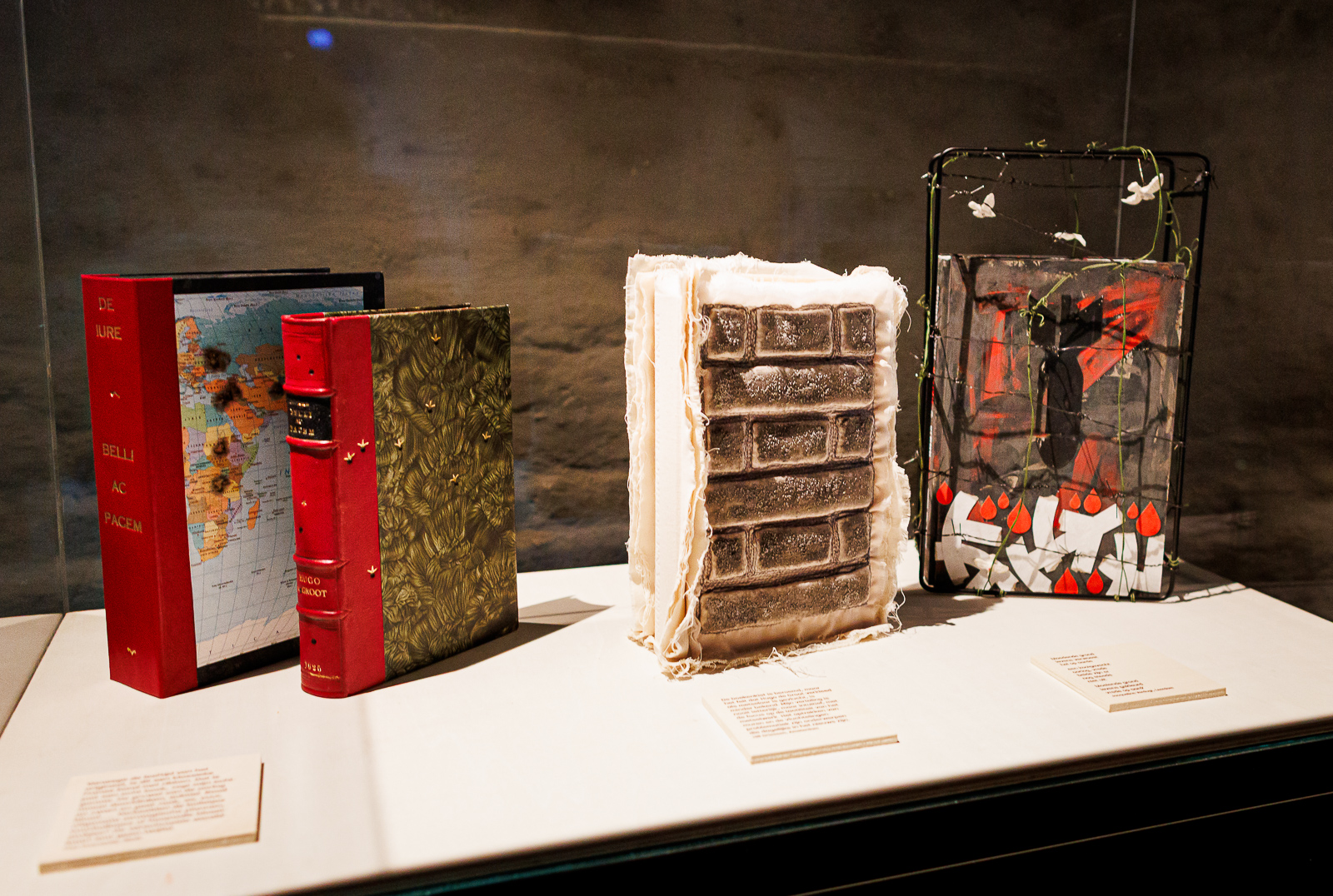
The horrors of war needed to resonate — subtly. Red, black, and yellow: smoke, ash, fire, blood… Do the dots represent strategic plans being set in motion, fireballs, or hopeful blossoms? The scorched world map leaves no doubt.
Piet Crauwels, Sluis
The book chest is famous, but the fact that Hugo Grotius escaped disguised as a bricklayer is less well known. My interpretation is never literal but intuitive, focusing on the tactile quality of masonry. The building of walls and the plight of refugees are subjects that feature in the news every day.
Hill Driessen, Amsterdam
Bleeding ground
lives destroyed
hell on earth
a cage fight
war, peace
both still
unresolved
Blooming ground
lives transformed
peace on earth
Jacqueline Verdugt, Leerdam
Display Case 3:
The front of the book portrays war with a shot-down dove of peace, its feathers stained with blood. The back symbolises peace. The coloured squares represent various peoples (rights), countries, and individuals — all different, yet united in peace.
The book is a German binding with hand-sewn headbands, bound in leather and inlaid with leather from furniture samples.
Fia Greven, Assen
A half binding with decorated headbands, a clasp, and metal corner pieces. The leather medallion is hand-tooled with the initials of Hugo Grotius (HG).
The book box was created from my own inspiration, all in the spirit of the late Middle Ages and inspired by the story of Grotius’s escape.
Dirk Demeulenaere, Sint-Kruis (B)
This historic book remains relevant today. That is why it has two spines: one historical, in leather, and one modern, in linen. It is easy to read — when you reach the end of Part I, you simply turn the book around and continue reading from the other side.
Gerard Borsboom, Oegstgeest
Display Case 4:
Limp calf-parchment binding with indirect lacing. Gathering paper 115 g Munken Print Crème 18. Trimmed gatherings, sewn with link stitches on three parchment slips. The book block is attached to the binding with braided laces. Reinforcement straps and a leather fastening strap with buckle are attached to the cover. Decorative braiding in hemp cord.
Thea Heinen, Nijmegen
A traditional English binding, sewn on double cords. The book edges are coloured in gold-brown ink. On the front board, the contours of the façade of Loevestein Castle appear in relief — the place where Hugo Grotius was imprisoned and from which he escaped in a book chest.
This book was made at De Boekwerkplaats in Stedum.
Mennie Oosterhuis, Groningen
Spitselband is a binding technique used in the time of Hugo Grotius. The clamshell box is white — the colour of peace, which I advocate. It forms a striking contrast with the brown, hand-dyed calf parchment honoring Hugo Grotius. Original 1730 hand-marbled paper was used for the endpapers.
Philipp Janssen, Kamperland
The contrasts in politics and religion are expressed in the rough suede side of the leather binding and the black-and-white headbands. The fiery orange streaks of the front hand-marbled endpaper refer to Maurice, son of William of Orange, who was responsible for Grotius’ imprisonment in Loevestein Castle.
Wiek Akkermans, Eefde
I dedicate this book to my late teacher Maria Atema, a specialist in working with parchment. The indirect laced-case structure, like the original, dates from the seventeenth century. Atema’s love and craftsmanship are reflected in the flexible (soft) parchment, and the flap with its clasps ‘embraces’ Peace.
Yvonne de Graaff, Herwijnen
Display Case 5:
The limp binding is inspired by the fourteenth-century Limp style. Made of recycled cardboard, reinforced with strips of leather and parchment. Sewn and wrapped with linen thread.
Thinking about war and peace brings me to the idea of connection, symbolised by the rings — perhaps more relevant now than ever.
Yvonne van Leeuwen, Haarlem
A Bradel binding, both bound and covered with Dyneema, making it resistant to bullet impacts. Bullet-proof vests are made of Dyneema, a super-strong fibre that breaks under its own weight only after 350 km.
The illustration on the front endpapers refers to war, while that on the back endpapers refers to peace.
Toon van Deijne, Haren (NB)
A book with a secret. Clad in an appropriate seventeenth-century ruff, it appears entirely innocent. But look closely: the yellow letters in the title reveal the word evasi — Latin for “I have escaped” — just like Hugo Grotius, who walked through Gorinchem disguised as a bricklayer. Nothing is as it seems.
Marianne Waldekker, Nijmegen
Hugo Grotius inspired me with his work De Iure Belli ac Pacis, in which he advocated tolerance and individual rights amid conflict. His intellectual strength and austere lifestyle were also a source of inspiration to me. This book, bound in black Gothic leather with a white title, reflects that restrained yet powerful spirit.
Max Polano, Zeist
How to give form to a classical book on law that, in our eyes, also legitimised injustice? A work dealing with international laws of war and peace whilst simultaneously offering moral comfort to colonisers and slave traders. I chose to make a beautiful book, executed in an antique binding style — with an ugly face.
Eveline Overdijk, Grootschermer