




Divide or Unite
RELIGIOUS OPPOSITES
Jacobus Arminius and the Remonstrants
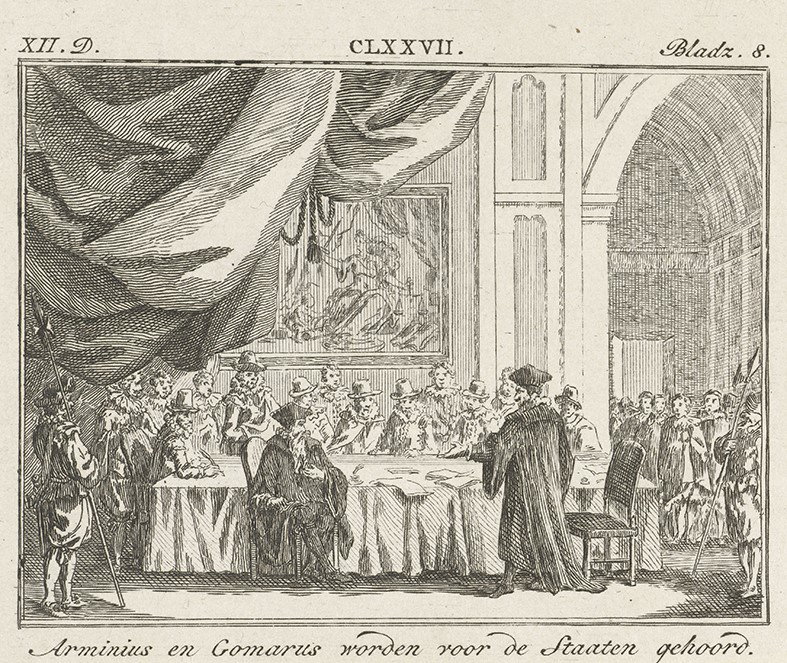
Jacobus Arminius believes that God determines who goes to heaven, based on how they live. Those who live well go to heaven; those who don’t, are not granted entry.
After Arminius’ death, the Arminians submit a petition for a revision setting out their views to the church. This request is called a remonstrance. The followers of Arminius begin to be called the Remonstrants.
Franciscus Gomarus and the Counter-Remonstrants
Franciscus Gomarus believes that God determines who goes to heaven and who does not. This is fixed before you are born and what one does in life has no influence over it.
The Gomarists respond to the Arminians’ request with a counter-request: the Counter-Remonstrance. The followers of Gomarus are called the Counter-Remonstrants.
Cartoon tit for tat
Both sides make cartoons about each other. Slowly, relations between them deteriorate. Throughout the country there are local riots.
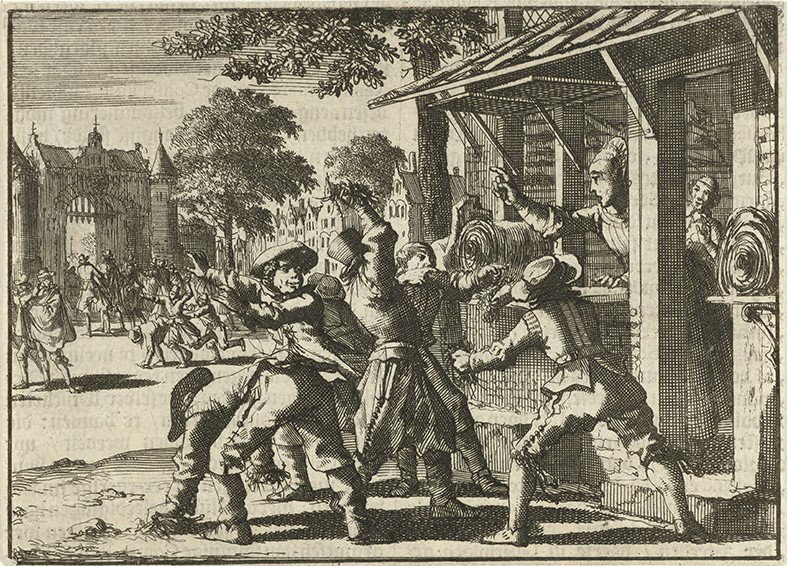
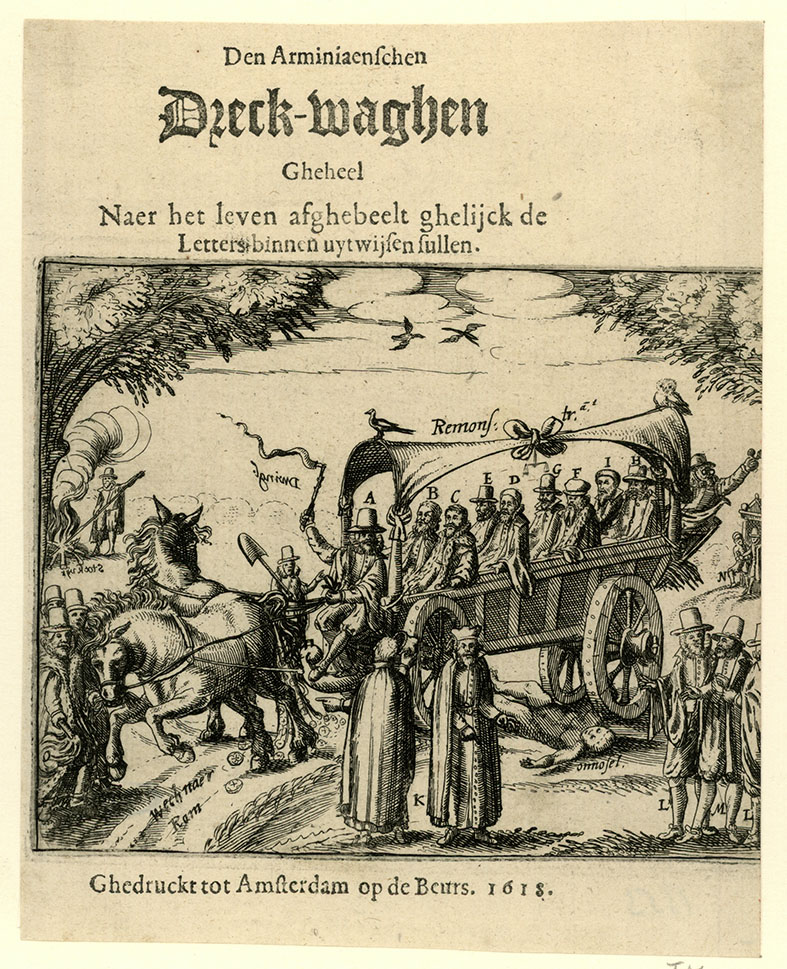
Attempts are made to reconcile the ideas of Arminius and Gomarus, but the conflict only escalates.
17th Century
POLITICAL OPPOSITES
Johan van Oldenbarnevelt
Johan van Oldenbarnevelt wants to cease war with Spain because of the (financial) costs. He thinks peace would be better for trade. In the ongoing religious dispute, he supports the Remonstrants. He believes everyone should be free to choose their own faith.
For Van Oldenbarnevelt, Holland’s independence is key. He tries to diminish Prince Maurits’ power by enabling cities to form their own mercenary armies.
Prince Maurits of Orange
Prince Maurits wants to continue the war with Spain. Contrary to Van Oldenbarnevelt, he sees war as beneficial to the economy, as it provides territory and war booty. He sides with the Counter-Remonstrants, mostly to restore the peace.
Prince Maurits is shocked when he hears that Van Oldenbarnevelt wants to allow cities to form their own armies. After all, this is his job. He thinks Van Oldenbarnevelt is far too tolerant, both religiously and politically, and sees this as treason.
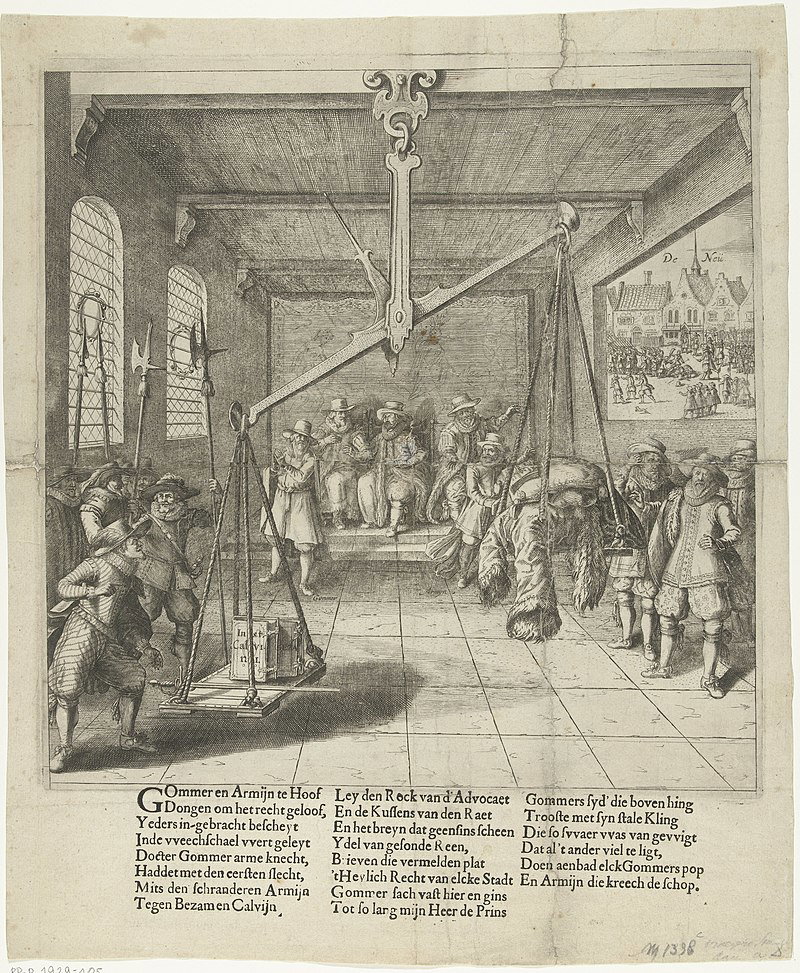
Maurits uses his power (the sword) to tip the balance and influence justice.
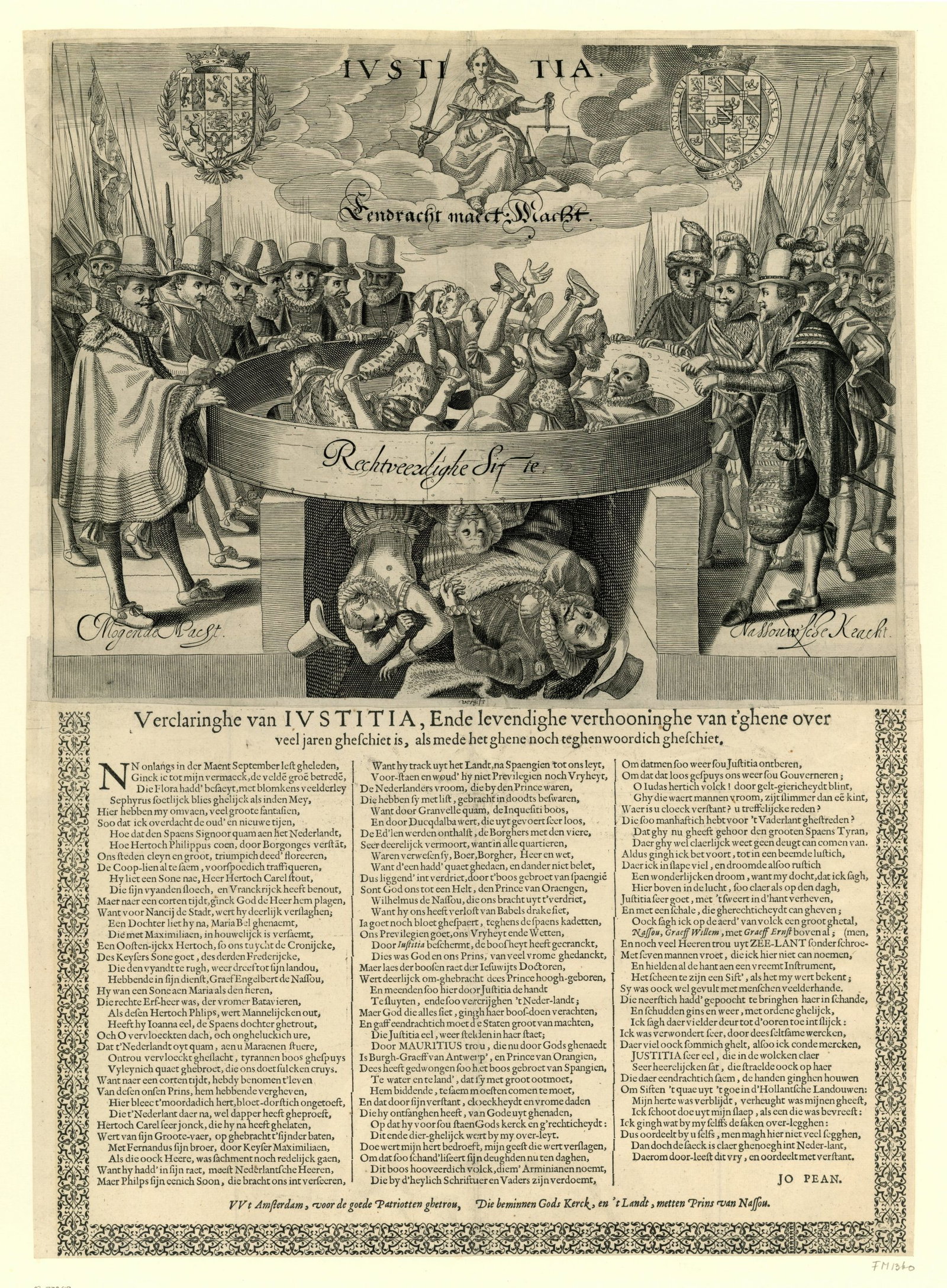
Maurice sifts Remonstrants out of society with the sieve of justice. There is no room for them in society, according to the printmaker.
Polarisation through pictures
Printed pamphlets are used to reach many people. To attract attention, these pamphlets often contain an eye-catching image with compelling text. In this way, people try to convince each other of their rightness and malign their opponent.
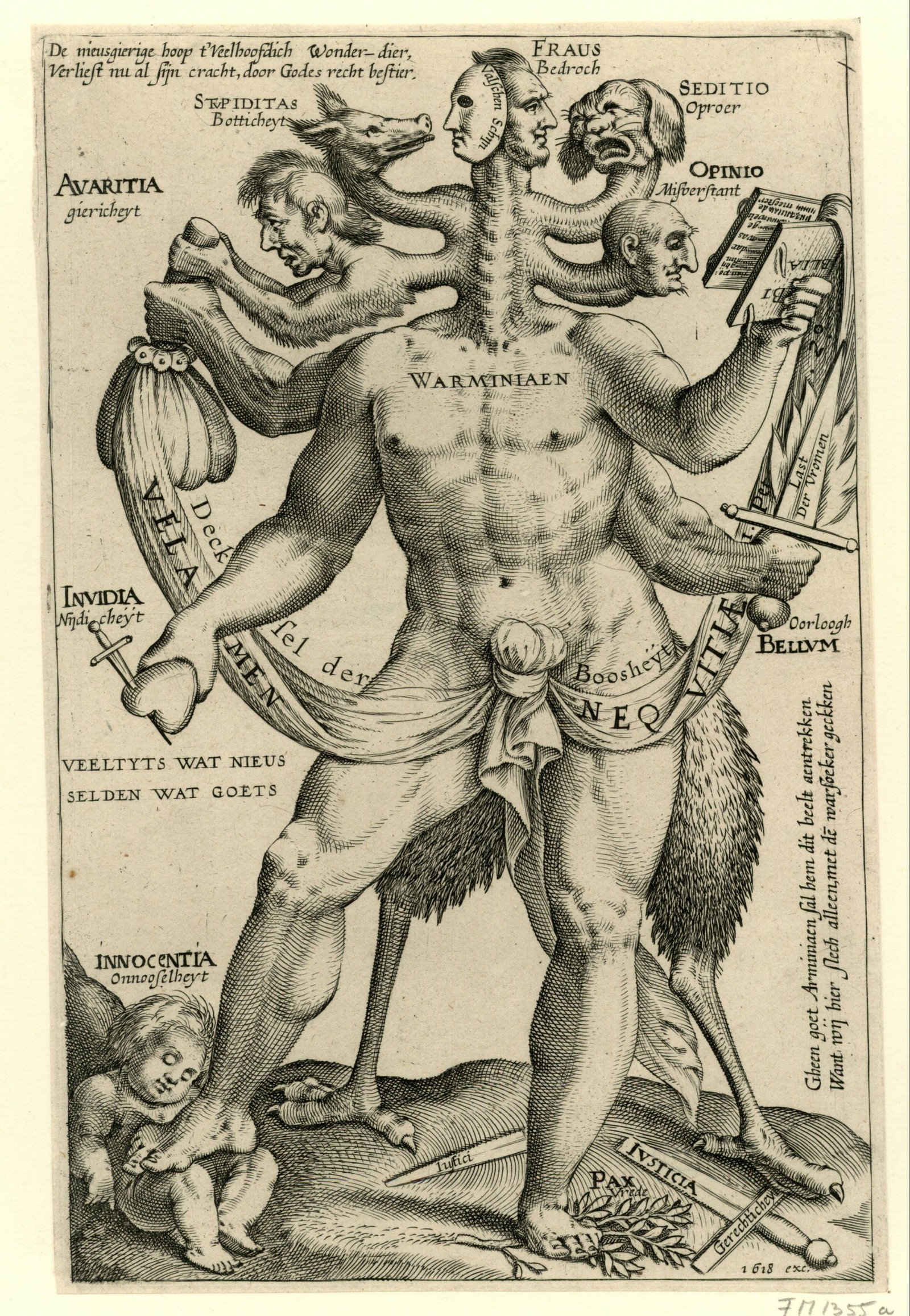
The Remonstrants (also known as Arminians) are portrayed as a five-headed monster.
Increasing polarisation
Tensions rise between Johan vvan Oldenbarnevelt and Prince Maurits. Van Oldenbarnevelt is keen to make peace with Spain. This leads to the Twelve Years’ Truce (1609-1621).
Prince Maurits sees the peace negotiations as a rapprochement with Spain. He distrusts this Catholic enemy and does not want an armistice.
His distrust of Van Oldenbarnevelt also grows. In 1619, he gets him arrested and convicted of high treason. Van Oldenbarnevelt is beheaded at the Binnenhof in The Hague.
This polarisation also has major consequences for Van Oldenbarnevelt’s supporters. Hugo Grotius and Rombout Hogerbeets are imprisoned in Slot Loevestein.
The consequences of polarisation
This print shows the consequences for the Remonstrants. Van Oldenbarnevelt is sentenced to death.Hugo Grotius and Rombout Hogerbeets are taken to their cells at Slot Loevestein. Gilles van Ledenberg commits suicide before his sentence. He still receives his punishment; his coffin is hung on the gallows. A number of ministers, including Johannes Wtenbogaert, are banished.

Hugo Grotius
Hugo Grotius is an important jurist. He supports Johan van Oldenbarnevelt and is therefore sentenced for life. He is imprisoned in this very room.
Hugo Grotius stays here with his wife Maria van Reigersberch and their children. Maria devises a clever plan, allowing Hugo to escape in a book chest after two years of imprisonment. He and his wife live in exile in France until his death.
Hugo Grotius’ book chest?
For years, the chest in this room was thought to be the one in which Grotius escaped from Slot Loevestein, until the castle keeper Van Rappard admitted in the 1980s that this was a fake. Nevertheless, the story of this chest is important and is part of the historical Canon of the Netherlands. Unfortunately, the real chest has been missing for 400 years.
Dispute
Nine times life sentence
After the Synod of Dort, Remonstrant ministers are no longer allowed to preach. Some of the ministers flee to Antwerp, where they establish the Remonstrant Brotherhood. There are also ministers who remain in the republic and secretly continue to preach.
Rewards are offered for reporting Remonstrant ministers. A manhunt ensues.
‘Eternal imprisonment’ (AV)
Nine Remonstrant ministers are imprisoned at Loevestein between 1621 and 1628. They are all given a life sentence. They are kept in small, dark and draughty rooms, often with their families. Their prisons are much like this room, divided into smaller cells.
The conspiracy against Maurits
While the ministers are locked up at Loevestein, an attack on Prince Maurits is planned in 1623. However, the plan is discovered and the conspirators, including the sons of Johan van Oldenbarnevelt, are arrested. Reinier van Oldenbarnevelt is beheaded, his brother Willem escapes and flees abroad.
The consequence of the failed attack (AV)
The atmosphere at Loevestein deteriorates after the failed attack on Maurits. When plague breaks out at Loevestein in 1625 and the ministers ask to be transferred, they are firmly told they have been placed at Loevestein ‘to die there’.
A written plea (AV)
The prisoners write many letters. Minister Johannes Wtenbogaert is one of the people they write to. Wtenbogaert is court minister to Prince Maurits and later counsellor to Johan van Oldenbarnevelt. When Arminius dies, he becomes the leader of the Remonstrants. This puts him at odds with Maurits.
In their letters, the prisoners describe the harsh conditions in which they are kept. Wtenbogaert uses the contents of these letters to gain support among his influential friends for the prisoners’ release.
The death of Maurits
In 1625, Maurits dies. His more moderate half-brother Frederick Hendrik succeeds him.
From 1627 onwards, Hendrik is more tolerant of the Remonstrant faith, but not much changes at Loevestein. The Counter-Remonstrants fear that turmoil will return to the Republic if the prisoners are released. They also fear that they will consequently lose their important position.
Easing conditions for the prisoners
When Prince Frederick Hendrik comes to power, life at Loevestein improves slightly. Rombout Hogerbeets is released, but the ministers continue to serve their sentences. There is even a ninth minister sentenced for life at Loevestein.
However, there is an easing in the harsh conditions for prisoners. Prisoners are allowed to meet each other, and there is more contact with the outside world. Letters are no longer checked and barrels of wine sent to the prisoners are allowed in.
The escape by night (AV)
In 1631, seven ministers are still imprisoned at Loevestein. Prince Frederick Hendrik wants to show that religious tolerance is important, but this imprisonment does not fit in with his idea of tolerance. However, he cannot simply release the ministers, because that would means loss of face.
Nor do the ministers themselves want to ask for their release; that would mean admitting guilt. The problem is cleverly solved with an escape! The ministers sail away unnoticed at night in a small boat. Soon after, their wives also get permission to leave.
Geesteranus
The married minister
Geesteranus thinks a lot about his former fiancée Suzanna van Oostdijk during his imprisonment. When he was forced to go into hiding, he withdrew his wedding vow to her.
After the death of Prince Maurits, prison rules ease a bit, and Geesteranus invites Suzanna to the prison. He soon asks her to marry him again.
On 22 December 1627, Father Geesteranus marries the two lovers here at Loevestein.
They then live in the kitchen below this room for four years. There, they have two daughters and a son. Their first child is born nine months after the wedding but unfortunately dies on the same day.
When Geesteranus escapes with the other six ministers in 1631, Suzanna and their children are free to go.
Suzanna is nicknamed ‘the Loevestein bride’ 200 years later. Their son, who also becomes a minister, calls himself ‘Justus van Loevestein’.
Polarisation Today
This part of the exhibition is composed by het Humanistisch Verbond (the Dutch Humanist Association).
Thinking freely, living together
That’s what the Humanist Alliance stands for. But how do you do that, living together? In practice, it’s not that simple. People sometimes stand firmly opposed to each other, battling from rock-solid positions and fixed opinions. Us versus them.
We invite you to look beyond clashing opinions.
Traditionally, the Humanist Association fights for humanity, for mutual respect. We don’t do this alone: with our 19,000 members, we make our voice heard loud and clear.
Do you also think a humane society is important? Get inspired by this exhibition. And join us. Together, we break the us-versus-them mentality.
What do you think? How polarised is the Netherlands?
Perceived polarisation is different from actual polarisation, as the facts and figures show.
Facts and figures
How polarised is the Netherlands according to research?
60% of adults in the Netherlands say they do not experience polarisation in their own environment. 40% do experience some degree of polarisation. Of these, 13% say they have less or no contact with some people because of polarisation.
Polarisation is not new. The current degree of polarisation in the Netherlands is similar to that in the 1970s. Percentage who agree and completely agree:
1970: 19%
1975: 11%
1980: 11%
2012/2013: 13%
2017/2018: 16%
2019: 15%
2022/2023: 9%
Compared to other European countries, polarisation in the Netherlands is relatively low.
Trust in other people is high. This has increased over the past 10 years, from 58% in 2012 to 66% in 2022.
Polarisation is greatest between people with different political preferences. When this coincides with other differences, such as education, age or urban or rural living environment, it reinforces negative feelings towards each other.
What role do social media play?
Filter bubble
Social media are sometimes seen as ‘filter bubbles’ in which dissenting voices are absent. But research shows that people actually come across different opinions more often online than in everyday life. Moreover, it is often easier to be rude or react aggressively online. As a result, hate becomes more visible there.
Fake news
A lot of fake news is spread on social media, which can affect your perception of reality. If different groups see a different reality, it can reinforce polarisation.
Social media are generally not the cause of polarisation, but can contribute to it.
Which hat are you wearing?
In polarisation, the other is often seen as opposites on one area, but of course everyone has many different sides. You can think of those sides as different ‘hats’ you wear.
You can wear different hats in one day, for example, you are a friend, a child of your parents and also a sports fan.
Is it really that black and white?
The different ‘hats’ you wear affect what you do, think and feel. As a result, your opinions may differ a bit depending on where you are and who you are talking to. Just as you are likely to wear different clothes at work than when you go for sports.
So opinions are not set in stone. They are part of a set of beliefs, doubts, suspicions and feelings. This is called inner polyphony. Nobody is just one voice.
How do I see myself and how do I see the other?
With us-them thinking, the other person is often labelled negatively, for example as a wimp, fortune hunter or climate follower. As a result, the other person is seen as just this one label instead of a human being with multiple sides.
From that, it’s a small step to thoughts like “I already know what this person thinks anyway” and “You really can’t talk to those types”.
So do you still see the other person as a serious interlocutor? Or can you see them as a multifaceted human being just like yourself?